
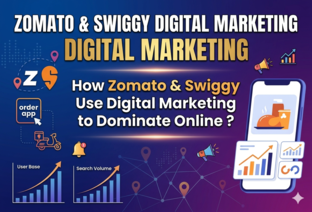
Zomato and Swiggy’s digital marketing strategy is one of the most studied and replicated playbooks in India’s booming food tech industry — and for very good reason. Zomato and Swiggy are not just food delivery apps — they are digital marketing powerhouses. Their ability to acquire millions of customers, retain them, and keep them engaged is a masterclass in modern marketing. In this in-depth article, we break down the exact digital marketing strategies that have made these two giants the undisputed rulers of India’s online food delivery market. Whether you are a food business owner, a marketing professional, or just a curious observer, this analysis will offer valuable insights. The core of Zomato and Swiggy’s digital marketing strategy lies in combining hyperlocal targeting with large-scale performance advertising. Zomato and Swiggy digital marketing strategy illustration showing social media ads and SEO. Swiggy online marketing tactics. And if you want similar strategies for your own brand, explore our marketing services.
Understanding Zomato and Swiggy’s digital marketing strategy helps food delivery app marketing strategy India food brands of all sizes build smarter, data-driven campaigns.
“Swiggy’s online marketing tactics focus on hyperlocal targeting, real-time push notifications, and viral social content that resonates with young Indian consumers.”Zomato social media marketing case study.”
“Zomato and Swiggy’s digital marketing strategy has redefined how food brands grow online — combining social media virality, data-driven advertising, and hyper-personalized user experiences to dominate India’s competitive food delivery market.”
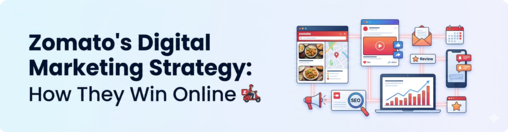
The Rise of Zomato and Swiggy: A Brief Context
Swiggy Online Marketing Tactics That Drive Millions of Orders
Zomato was founded in 2008 as a restaurant discovery platform and gradually evolved into a full-stack food delivery company. Swiggy launched in 2014 and quickly became Zomato’s biggest rival. Together, they process hundreds of millions of food orders annually and together hold over 90% of India’s online food delivery market share. What sets them apart is not just their logistics network or restaurant partnerships — it is their extraordinary digital marketing engine.
“A winning food delivery app marketing strategy Zomato social media marketing case study in India must combine performance advertising with strong organic SEO — exactly what both Zomato and Swiggy have mastered.”
1. Social Media Marketing: The Backbone of Their Brand
Zomato’s Social Media Strategy
Zomato social media marketing case study Food delivery app marketing strategy India Zomato’s Twitter and Instagram presence is legendary in Indian marketing circles. Their social media team creates content that is funny, topical, and incredibly shareable. They leverage trending topics, memes, and cultural moments to stay relevant in the daily conversation of millions of young Indians. Some of their most viral campaigns have had nothing to do with food directly — but they created massive brand recall.
Swiggy’s Social Media Approach
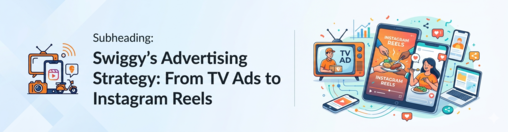
Food delivery app marketing strategy India Swiggy’s social media strategy focuses on relatable food moments — late-night cravings, office lunch dilemmas, and monsoon comfort food. Swiggy online marketing tactics their Instagram Reels and short-form videos consistently go viral because they speak directly to the everyday experiences of their target audience. Both brands invest heavily in social media advertising, targeting users based on location, food preferences, and ordering behavior. Learn how we can build this for your brand.
2. Performance Marketing: How They Acquire Customers at Scale
Google Ads & Search Marketing
Zomato Swiggy digital marketing strategy both platforms bid aggressively on high-intent keywords like ‘food delivery near me’, ‘order pizza online’, and ‘best biryani in Bangalore’. Their search ads appear at the top of Google results pages and are geographically targeted to show only to users in their delivery radius. food delivery app marketing strategy India. They also leverage Google’s display network to retarget users who have visited their apps but have not yet converted.
“This Zomato social media marketing case study reveals how a single witty tweet can generate more brand awareness than a paid campaign worth lakhs of rupees.”
Meta Ads & Social Advertising
Zomato and Swiggy use Meta’s sophisticated targeting tools to reach users based on demographics, interests, and past behavior. They run dynamic product ads that show personalized restaurant recommendations to each user based on their ordering history and preferences. During peak times like lunch hours, dinner time, or major holidays, both brands ramp up their ad spend significantly.
3. App Store Optimization (ASO) and SEO Strategy
With hundreds of millions of app downloads, Zomato and Swiggy have invested heavily in App Store Optimization to ensure they rank at the top of Google Play Store and Apple App Store for food-related searches. Their websites are also SEO powerhouses. Zomato alone has millions of indexed pages — individual restaurant pages, city-specific pages, cuisine category pages, and blog content. This massive SEO footprint ensures they capture organic traffic from every conceivable food-related search query. A key element of Zomato and Swiggy’s digital marketing strategy is their massive SEO footprint, with millions of indexed pages capturing every food-related search.
4. Content Marketing and Blogging
Zomato Swiggy digital marketing strategy both companies maintain active content marketing operations. Zomato’s blog and in-app editorial content covers food trends, restaurant reviews, chef interviews, and city food guides. This content not only attracts organic traffic but also positions Zomato as a food authority — not just a delivery platform. Swiggy’s content hub focuses on grocery trends, quick recipes, and home cooking tips. About Astute Agency — we help food brands build powerful content strategies.
5. Email and Push Notification Marketing
One of the most underrated aspects of Zomato and Swiggy’s marketing is their precision in email and push notification campaigns. They use behavioral data to send hyper-personalized communications — notifying users about discounts on their favorite cuisines, reminding them when their last order was placed, and promoting new restaurant openings in their neighborhood. Push notifications are timed to coincide with meal times and personalized based on past ordering patterns.
6. Influencer Marketing and Celebrity Partnerships
How Zomato uses digital marketing both platforms have run large-scale influencer marketing campaigns with food bloggers, lifestyle influencers, and even Bollywood celebrities. These campaigns build credibility, extend reach, and create buzz around new features or offers. Zomato partnered with several IPL teams and ran massive co-branded campaigns during cricket season, while Swiggy’s ‘Swiggy Voice of Hunger’ campaign went viral nationally.
7. Personalization and Data-Driven Marketing
Perhaps the most powerful aspect of both companies’ marketing is their use of data. Every user interaction — from what they search to what they order — is tracked and fed into marketing algorithms that create increasingly personalized experiences. Personalized homepages, AI-powered restaurant recommendations, dynamic discounting based on price sensitivity, and geo-targeted offers are all powered by sophisticated data science.
8. Hyperlocal Marketing
How Zomato and swiggy uses digital marketing have perfected hyperlocal marketing — targeting users based on their precise geographic location. During events like a cricket match or a local festival, they push relevant offers to users in specific areas, maximizing relevance and conversion. Hyperlocal digital marketing is also available for smaller food businesses and restaurants. Contact Astute Agency today to learn how we can implement hyperlocal strategies for your food brand.
What Food Businesses Can Learn from Zomato and Swiggy
- Invest in social media content that is authentic, relatable, and consistent
- Use performance marketing to acquire and retarget customers with precision
- Build an SEO-optimized website with rich local content
- Leverage email marketing and push notifications for retention
- Work with influencers who align with your brand values
- Use data to personalize customer experiences at every touchpoint
Community Building and Brand Loyalty Strategies
Beyond the transactional aspects of food delivery, both Zomato and Swiggy have invested significantly in community building initiatives that create emotional connections with their users. Zomato’s restaurant review ecosystem transformed ordinary diners into food critics, giving users a sense of identity and belonging within the platform. This user-generated content strategy not only created massive volumes of authentic content but also generated deep platform loyalty that transcended purely functional food delivery.
Food delivery app marketing strategy India swiggy’s community building approach has focused more on creating cultural moments around food. Their campaigns like ‘What Did India Order’ annually reveal fascinating food ordering patterns across cities and occasions, generating enormous media coverage and social sharing. These data-driven storytelling campaigns transform proprietary data into compelling brand narratives that position Swiggy as the authority on India’s food culture rather than merely a logistics provider.
Loyalty Programs and Retention Marketing
Zomato Gold and Swiggy One represent sophisticated subscription-based loyalty programs that go far beyond simple discount mechanics. By offering tiered membership benefits including free deliveries, exclusive restaurant access, and priority customer service, these programs create a committed core of high-frequency users who contribute disproportionately to overall revenue. The psychology of subscription loyalty means that members actively justify their subscription cost by ordering more frequently, creating a virtuous cycle of engagement and revenue.
The retention marketing strategies deployed by both platforms involve sophisticated lifecycle management. Using predictive analytics, they identify the precise moment when a user’s ordering frequency begins to decline and intervene with targeted re-engagement offers before the user fully churns. This proactive approach to retention is significantly more cost-effective than reactive win-back campaigns and demonstrates the power of combining data science with behavioral marketing psychology.
Festive and Event-Based Marketing Campaigns
Seasonal and event-based marketing represents one of the highest-impact opportunities in the food delivery marketing calendar. Both Zomato and Swiggy have developed sophisticated playbooks for leveraging cultural moments including cricket matches, Diwali, Eid, New Year’s Eve, and regional festivals to drive extraordinary order volumes. During the IPL season, for example, both platforms create integrated marketing campaigns that combine performance advertising, influencer partnerships, and exclusive restaurant deals to capture the massive surge in food ordering that accompanies evening match viewings.
The creative execution of these campaigns demonstrates exceptional cultural intelligence. Rather than generic promotional messaging, the most successful campaigns tap into the specific emotional tenor of each occasion. Zomato’s messaging around monsoon comfort food evokes nostalgia and warmth, while their Diwali campaigns balance the festive spirit of celebration with the practical convenience of their platform. This cultural sensitivity in campaign planning separates best-in-class food marketing from generic promotional activity.
Technology-Driven Marketing Innovations
Both companies have pushed the boundaries of marketing technology to create unprecedented customer experiences. Zomato’s in-app discovery features use machine learning to surface restaurants aligned with each user’s taste profile, effectively making the home screen a personalized food discovery engine for every user. The marketing value of this feature is immense: rather than generic category browsing, users encounter a curated world of food that feels made for them personally.
Swiggy’s investments in dark store networks for instant grocery delivery (Swiggy Instamart) required an entirely new marketing approach. Unlike restaurant food delivery which satisfies an immediate craving, grocery delivery needed to create habitual shopping behavior. Swiggy’s marketing campaigns for Instamart focused on repositioning the grocery shopping mindset from a planned weekly activity to an on-demand convenience, fundamentally changing consumer behavior through sustained marketing communication.
Voice search optimization and conversational AI are emerging frontiers where both companies are investing. As smart speaker adoption grows in Indian urban homes, optimizing for voice-based food ordering commands represents the next frontier of performance marketing. The brands that establish dominance in voice search results for food ordering queries will capture a significant first-mover advantage in this growing channel.
Pricing Psychology and Promotional Marketing in Food Delivery
How Zomato uses digital marketing one of the most sophisticated aspects of Zomato and Swiggy’s marketing playbooks is their mastery of pricing psychology. Both platforms deploy a nuanced array of promotional mechanics that go far beyond simple discounts. Dynamic pricing that fluctuates based on demand, time of day, and weather conditions creates the perception of value optimization that encourages users to order at optimal times. Limited-time offers with countdown timers create urgency that drives immediate action. Minimum order thresholds for free delivery nudge customers to add additional items, increasing average order values.
The psychological principle of loss aversion is particularly prominent in their promotional strategy. ‘You have X coins expiring soon’ and ‘Your saved discount expires tonight’ messages leverage the human tendency to feel losses more strongly than equivalent gains. This approach consistently outperforms equivalent positive-framing messages in driving immediate orders. For food businesses studying their marketing, understanding and ethically applying these pricing psychology principles can significantly improve promotional campaign conversion rates without increasing discount depth or marketing spend.
Subscription framing is another area where both platforms demonstrate sophisticated behavioral marketing. By presenting Zomato Gold and Swiggy One memberships as ‘unlimited savings’ rather than a fixed monthly fee, they shift the mental accounting from a cost to an investment. Members then actively seek opportunities to use their subscription benefits, organically increasing order frequency to justify their perceived investment. This subscription psychology creates a virtuous cycle of engagement that benefits both the platform and participating restaurants through higher volumes and more predictable demand patterns. Data-driven advertising forms the backbone of Zomato and Swiggy’s digital marketing strategy, ensuring maximum ROI on every rupee spent.
The Role of Customer Feedback Loops in Marketing Refinement
A critical but often overlooked component of Zomato and Swiggy’s marketing excellence is their sophisticated customer feedback infrastructure. Both platforms have built comprehensive systems for collecting, analyzing, and acting on customer feedback that go far beyond simple star ratings. Every complaint, compliment, and suggestion is treated as a valuable data point that informs marketing messaging, product positioning, and campaign creative.
The marketing implications of this feedback orientation are significant. When analysis of customer reviews reveals that delivery speed is consistently cited as the primary reason for choosing a platform, performance marketing campaigns immediately emphasize speed-related messaging. When data shows that customers in a particular city are particularly price-sensitive, promotional campaigns in that geography are calibrated accordingly. This tight feedback loop between customer sentiment and marketing execution ensures campaigns remain perpetually relevant and resonant with evolving consumer priorities.
For smaller food businesses replicating this approach, the equivalent practice involves systematic monitoring of Google reviews, Zomato and Swiggy ratings, and social media mentions to identify recurring themes in customer feedback. Creating a simple monthly ritual of reviewing this feedback and translating key insights into marketing message adjustments can meaningfully improve campaign relevance and conversion rates without requiring sophisticated technology infrastructure.
Lessons for Mid-Size Food Businesses and Restaurant Chains
While Zomato and Swiggy operate at a scale that is simply unreachable for most food businesses, their marketing principles are entirely applicable at smaller scales. The core philosophy of data-driven personalization, community building, and authentic cultural storytelling translates equally well whether you are a 10-outlet regional chain or a single cloud kitchen.
For regional restaurant chains looking to build digital marketing capabilities, the most important lesson from Zomato and Swiggy is the primacy of owned digital channels. While both platforms benefited enormously from third-party distribution, their investment in owned apps, websites, and CRM systems created the data infrastructure that powers their personalized marketing. Independent restaurants and regional chains should prioritize building owned digital touchpoints — their own ordering apps or websites — rather than depending entirely on aggregator platforms that limit direct customer relationships.
Video Content and OTT Advertising as Emerging Channels
Both Zomato and Swiggy have expanded their marketing presence into video content and OTT (over-the-top) advertising platforms as Indian digital audiences spend increasing amounts of time on streaming services. Connected TV advertising on platforms like Disney+ Hotstar, JioCinema, and Netflix allows both brands to reach premium audiences during high-viewership content windows including IPL matches, popular web series, and live events. The combination of sight, sound, and motion in a lean-back viewing environment creates advertising impact that performance channels alone cannot replicate.
Short-form video advertising on YouTube and Instagram has become a core component of their always-on media strategy. Swiggy and Zomato both invest in producing high-quality 15 to 30-second video ads that blend humor, cultural resonance, and clear product messaging to cut through the clutter of digital advertising. These video assets are then repurposed across platforms — from pre-roll YouTube ads to Instagram Stories placements — maximizing production investment across multiple touchpoints.
The strategic use of content marketing through long-form video series and branded entertainment is an emerging frontier where both companies are experimenting. Food-culture documentaries, chef collaboration series, and behind-the-scenes kitchen content serve a brand-building function that complements the performance advertising driving immediate orders. This dual investment in both brand equity and performance marketing creates a balanced marketing portfolio that delivers results across both short-term conversion and long-term brand value metrics. For food businesses of all sizes, adopting a similarly balanced approach — combining brand storytelling with performance-driven advertising — is a proven formula for sustainable growth in competitive digital markets.
“Swiggy’s online marketing tactics have evolved from basic discounts to sophisticated AI-driven personalization that predicts what a user wants to order before they even open the app.”
Conclusion
Zomato and Swiggy’s digital marketing dominance is not accidental — it is the result of strategic, consistent, and data-driven execution across every marketing channel. By studying and adapting their strategies, food businesses of all sizes can grow their online presence and customer base. To implement world-class digital marketing for your food brand, visit Astute Agency’s homepage or get in touch with our team.
Zomato social media marketing case study any food brand looking to grow online can take inspiration directly from Zomato and Swiggy’s digital marketing strategy and adapt it to their own scale and budget. Food brands of all sizes can learn from Zomato and Swiggy’s digital marketing strategy and apply these same principles at their own scale.
“Any food delivery app marketing strategy in India must account for regional preferences, vernacular content, and hyperlocal seasonal trends — all of which Zomato and Swiggy execute flawlessly.”
Via social media, SEO, and ads.
Personalized & data-driven.
Yes, food bloggers & celebs.
Millions of indexed local pages.
Timed to meal hours & habits.
Yes, on a smaller budget.
Geo-targeted area-based ads.
Yes, heavily on food keywords.